Coffee Machine Buying Guide: How to Choose the Right Coffee Machine in Singapore
By the Di Pacci Team · Espresso specialists shipping DHL Express across Singapore · Updated September 2026
6machine types explained
7step decision process
18FAQs answered
15+years of Di Pacci coffee expertise
The short version
The right coffee machine is the one that matches your routine, not the most expensive model. Decide how much hands-on control you want first.
The grinder matters as much as the machine. A capable machine paired with a poor grinder will underperform every time.
For most Singapore homes, a compact tank-fill semi-automatic or a bean-to-cup machine covers daily coffee comfortably.
Singapore's warm, humid climate affects bean storage and descaling, so factor water and maintenance into your choice.
Milk drinkers should confirm the machine has a proper steam wand or automatic milk system before buying.
01
Why your coffee machine choice matters
Short answer: The best coffee machine is not a single model. It is the machine that fits how you actually make coffee, how much control you want, your budget, your bench space and your milk-drink habits.
Two people can spend the same money and be equally happy or equally frustrated, depending on whether the machine suits them. A café owner needs recovery speed and durability. A busy parent may value one-touch convenience above all. A weekend home barista may want manual control and a machine they can dial in.
So before comparing models, it helps to be honest about ten things: your usual coffee style, your skill level, how much convenience you want, your budget, how often you brew, your kitchen space, how much control you want, whether you need a grinder, whether you make milk-based drinks, and how much cleaning you are willing to do. This guide works through each of these so you finish knowing which category suits you, rather than being pushed towards one brand.
02
Quick buying guide
If you want a fast starting point, this table maps a common goal to the machine category worth considering. None of these is universally best. Suitability depends on your needs, which the rest of the guide explains in detail.
If you want...
Consider...
Convenience with minimal effort
Automatic or bean-to-cup coffee machine
Maximum control over the shot
Manual or semi-automatic espresso machine
Freshly ground coffee, one touch
Bean-to-cup machine (integrated grinder)
Cafe-style espresso at home
Semi-automatic espresso machine plus a good grinder
Easy milk drinks
Automatic milk system or a steam wand you texture yourself
There are six broad categories. The main difference between them is how much the machine does for you versus how much you do yourself. More automation means more convenience and less control; more manual operation means more control and a steeper learning curve.
How they work: You control the pump pressure by hand, usually with a lever that you pull. The machine heats water and provides pressure through your own physical action, giving you direct influence over pre-infusion and the pressure profile of the shot.
Advantages: Complete control over extraction, a quiet operation, striking design, and a genuinely engaging ritual. Limitations: A real learning curve, inconsistent results until you build technique, and no automation.
Grinder requirement: Essential and demanding. A lever machine exposes grind faults immediately, so a quality burr grinder is non-negotiable.
Best suited to: Enthusiasts who enjoy the craft, want a hands-on ritual, and are willing to practise. Not ideal for anyone who wants a quick cup before work.
How they work: An electric pump provides consistent pressure, but you control the grind, dose, tamp and shot timing. You start and stop the shot yourself. This is the classic "barista at home" experience.
Level of control: High. You decide every variable except pump pressure, which the machine holds steady. Learning curve: Moderate. Most people are pulling enjoyable shots within a week or two of practice.
Grinder requirement: Essential. Semi-automatics do not grind, so budget for a separate grinder. Milk steaming: Usually a manual steam wand, which gives excellent microfoam once you learn to texture milk.
Best suited to: Home baristas who want cafe-quality espresso and are happy to grind, dose and steam themselves. See home coffee machines.
Automatic Coffee Machines Programmed shots
Automation: Similar to a semi-automatic, but the machine measures the shot volume for you using programmed dosing, so it stops pouring automatically. You still handle grinding, dosing and often milk.
Convenience: Repeatable shot volumes without watching a timer. Milk systems: Range from a manual steam wand to an automatic frother, depending on the model. Cleaning: Comparable to a semi-automatic, with the group and steam wand needing regular attention.
Best suited to: People who want espresso-machine quality with slightly less fuss around shot timing and repeatability.
Integrated grinder: A bean-to-cup machine grinds fresh beans, doses, tamps, brews and often froths milk automatically at the press of a button. One-touch preparation: Many models deliver a full latte or cappuccino without you touching a portafilter.
Grind adjustment: Most allow you to change grind size and strength within limits. Milk options: Built-in carafes or automatic frothers are common. Maintenance: The brew unit and milk circuit need regular cleaning, and automatic cleaning cycles handle much of this.
Best suited to: Busy households and offices that want fresh-ground coffee and milk drinks with minimal effort. See automatic machines.
Convenience and consistency: You drop in a sealed capsule and press a button. Results are consistent from cup to cup with almost no skill required. Capsule costs: The machine is usually inexpensive, but the per-cup cost of capsules adds up over time.
Coffee freshness: Capsules are sealed for shelf life rather than peak freshness, so flavour is convenient rather than specialty-grade. Environmental considerations: Single-use capsules create waste, though some are recyclable or compostable.
Best suited to: Light coffee drinkers, guest rooms, and anyone who values simplicity over control or cost per cup. Browse pod machines.
Capacity and workflow: Built for repeated back-to-back extractions with fast steam and quick recovery, so a queue of orders does not slow the machine down. Durability: Heavier components designed for daily commercial use. Plumbing and power: Many require a direct water connection and, in Singapore, appropriate electrical provisioning; larger multi-group machines can need dedicated circuits.
Short answer: Spend according to how you will use the machine, not according to a fixed figure. As you move up in price you generally gain better temperature stability, build quality, steam power and grinder capability, but price alone does not guarantee the machine suits you.
Rather than quote prices that go out of date, it is more useful to think in tiers. What you gain moving up is usually consistency, longevity and control, not simply a bigger number.
Entry-level
Getting started
Capsule machines, basic semi-automatics and entry bean-to-cup. Convenient and affordable, with limited control and modest steam power.
Mid-range
Everyday quality
Capable semi-automatics and solid bean-to-cup machines. Better temperature stability, a usable steam wand, and room to improve your technique.
Premium home
Serious home setup
Machines with PID control, stronger boilers and a proper 58mm portafilter. Paired with a good grinder, this tier reaches cafe-level results.
Prosumer
Home barista
Heat exchanger and dual boiler machines built for simultaneous brewing and steaming, with the stability and steam power keen home baristas want.
Commercial
Business grade
Multi-group machines built for volume, recovery speed and durability, usually plumbed in and provisioned for continuous service.
A practical rule for espresso: split your budget between the machine and the grinder rather than spending everything on the machine. Machine and grinder packages can make that split easier. Prices change with model and availability, so always check the current listing.
Pricing not stated in this guide by design. For current Singapore pricing, check the live product pages, as figures change with model, promotion and availability.
05
Do you need a built-in grinder?
This is one of the most important early decisions, because it shapes both your workflow and your bench space.
Advantages: Convenience, space saving, and an integrated grind-to-brew workflow. This is what a bean-to-cup machine offers. Considerations: The built-in grinder may be less flexible or less capable than a good standalone grinder, and it is harder to upgrade independently.
Separate grinder
Advantages: A far wider choice of grinders, the freedom to upgrade the grinder without replacing the machine, and independent, precise adjustment. Considerations: Extra cost, extra bench space, and an additional piece of equipment to clean.
Who should choose which: Choose a built-in grinder if convenience and space are your priority. Choose a separate grinder if you want the best possible espresso, the ability to fine-tune, and the option to upgrade over time. Compare grinders.
06
How important is the grinder?
Short answer: For espresso, the grinder is as important as the machine, sometimes more so. Grind consistency and adjustability decide how evenly your coffee extracts, and no machine can compensate for an uneven grind.
Burr vs blade: Burr grinders crush beans between two burrs to a consistent, adjustable size. Blade grinders chop unevenly and cannot be dialled in, so they are unsuitable for espresso. For any serious coffee, a burr grinder is the standard.
Grind size and consistency: Espresso needs a fine, uniform grind. Uniform particles extract evenly; uneven particles cause channelling, where water rushes through gaps and leaves the rest under-extracted.
Dose control and adjustment: Good grinders let you set the dose and make fine grind adjustments. Stepless adjustment gives the finest control, which matters most for espresso. Retention and single dosing: Low-retention grinders waste less coffee between doses, and single-dosing suits people who switch beans often.
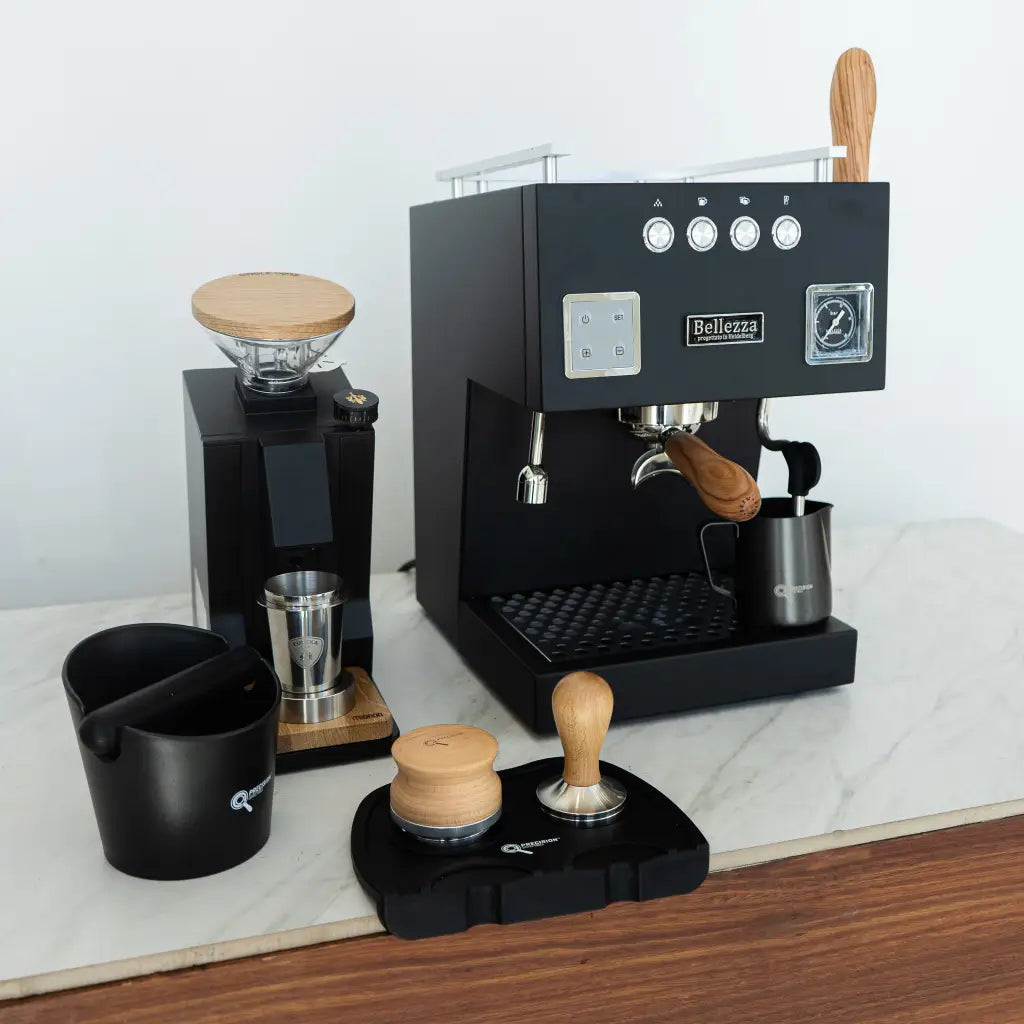
Espresso vs filter grinding: Espresso needs a fine grind under pressure; filter and pour-over need a coarser grind. A grinder with a wide adjustment range covers both. If espresso is your goal, prioritise a grinder built for fine, consistent output. The Eureka Mignon XL 65E is one example of a home espresso grinder, and the wider grinder range covers other needs.
07
Brewing systems explained
The heating system inside an espresso machine affects temperature stability and whether you can brew and steam at the same time. No system is universally best; each suits a different user.
Thermoblock
What it is: A compact heating element that heats water on demand as it passes through. How it works: Water flows through a heated block rather than sitting in a boiler. Advantages: Fast heat-up, compact, and energy efficient. Limitations: Temperature can be less stable across a shot, and steaming while brewing is limited. Who should consider it: Occasional users who value quick warm-up and a small footprint.
Dual thermoblock
What it is: Two separate thermoblocks, one for brewing and one for steaming. How it works: Each function has its own heater, so you can brew and steam without waiting. Advantages: Faster workflow than a single thermoblock and quick heat-up. Limitations: Still generally less thermally stable than a good boiler system under heavy use. Who should consider it: Home users who make milk drinks and want speed in a compact machine.
Single boiler
What it is: One boiler that handles both brewing and steaming, switching between the two. How it works: You brew at one temperature, then switch the boiler to a higher temperature for steam. Advantages: Simple, affordable and compact. Limitations: You cannot brew and steam simultaneously, so there is a short wait between the shot and the milk. Who should consider it: Solo drinkers and those who make one or two milk drinks at a time.
Heat exchanger
What it is: A single boiler with a pipe running through it that draws fresh water for brewing. How it works: The boiler stays hot for steam while brew water is heated on the way to the group. Advantages: Brew and steam at the same time, with strong steam power. Limitations: Brew temperature needs managing, often with a short flush before pulling a shot. Who should consider it: Home baristas who make several milk drinks and want commercial-style workflow.
Dual boiler
What it is: Separate boilers for brewing and steaming, each independently controlled. How it works: One boiler holds brew temperature, the other holds steam pressure, usually with PID control. Advantages: Excellent temperature stability and simultaneous brew and steam. Limitations: Larger, more expensive, and higher power draw. Who should consider it: Committed home baristas and small venues that want the most consistent results.
Automatic brewing systems
What it is: The integrated brew unit inside a bean-to-cup machine. How it works: The machine grinds, doses, tamps and brews internally with programmed parameters. Advantages: One-touch consistency with no barista skill required. Limitations: Less manual control over extraction variables. Who should consider it: Anyone prioritising convenience and repeatability over hands-on control.
08
Pressure, temperature & extraction
These are the variables that decide how your espresso tastes. You do not need to master them to buy a machine, but understanding them helps you choose sensibly.
Brewing pressure: Espresso is traditionally extracted at around 9 bar at the group. Many machines advertise 15 or 20 bar pump ratings, but that is the pump's maximum, not the pressure at the coffee. More advertised bar does not mean better coffee.
Pump types: Vibration pumps are compact and common in home machines; rotary pumps are quieter and smoother and are usual in commercial machines.
Temperature stability: Consistent brew temperature produces consistent flavour. PID control and better boiler systems improve stability.
Pre-infusion: A gentle wetting of the coffee before full pressure. It can improve evenness and reduce channelling.
Extraction and brew ratio: Extraction is how much flavour is dissolved from the grounds. Brew ratio is the weight of coffee in versus espresso out, commonly around 1:2 for a standard shot.
Grind size, dose and brew time: These three work together. A typical espresso shot uses a set dose, a fine grind, and a brew time of roughly 25 to 30 seconds, adjusted to taste.
The takeaway: temperature stability and grind quality matter far more than a high advertised bar rating. Judge a machine on its boiler system, PID and build, not its headline pressure number.
09
Steam wands & milk systems
If you drink lattes, flat whites or cappuccinos, the milk system is one of the most important parts of the machine.
A manual steam wand produces the best microfoam for a flat white, latte, cappuccino or macchiato once you learn to texture milk, and it rewards practice. Automatic systems trade a little quality for consistency and speed. Whichever you choose, remember milk systems need cleaning after every use, and automatic carafes need regular rinse cycles to stay hygienic. Milk jugs help if you steam manually.
10
Coffee machine features that actually matter
Not every feature matters to every buyer. Here is what each one does and who benefits, so you can tell essential from optional for your situation.
Grinds fresh beans inside the machine. Benefits convenience-focused buyers; optional if you have a separate grinder.
Grind adjustment
Lets you change grind size to dial in extraction. Valuable for espresso; less critical for pods.
Dose control
Sets how much coffee is used per shot. Helps consistency for home baristas.
Programmable dosing
Stores shot volumes so the machine stops automatically. Useful for repeatability and busy mornings.
PID temperature control
Holds brew temperature precisely. Important for consistent espresso; optional for casual users.
Pre-infusion
Gently wets the puck before full pressure. Improves evenness; a nice-to-have for most homes.
Pressure gauge
Shows brew or boiler pressure. Helpful feedback for learners and enthusiasts.
Touchscreen / digital display
Simplifies menu navigation and profiles. Convenience feature, not essential.
Automatic cleaning & descaling
Runs rinse and descale cycles. Very useful for bean-to-cup owners.
Water filter
Reduces scale-forming minerals. Genuinely valuable in hard-water areas.
Adjustable brew & milk temperature
Tailors drinks to taste. Optional but appreciated by particular drinkers.
Cup warmer
Pre-warms cups so espresso holds temperature. Minor but pleasant.
Hot water outlet
Dispenses hot water for long blacks and tea. Handy for mixed households.
Dual beverage & user profiles
Makes two cups at once or saves settings per person. Great for families and offices.
No single feature is essential for everyone. Match features to how you brew: a milk drinker prioritises the steam system, an espresso purist prioritises PID and grind adjustment, and a busy office prioritises user profiles and automatic cleaning.
11
Coffee drinks & machine choice
Your usual order should influence your machine. If you rarely drink milk coffee, you can prioritise the espresso side; if you live on lattes, the milk system matters most.
Coffee drink
Machine considerations
Espresso
Prioritise temperature stability, a good grinder and grind adjustment. Milk system is secondary.
Long black
Espresso plus a hot water outlet is ideal, though not essential.
Americano
Similar to long black; a hot water outlet adds convenience.
Flat white
Needs a capable steam wand or automatic milk system for fine microfoam.
Latte
Larger milk volume, so steam power and a good jug or carafe help.
Cappuccino
Needs well-textured, airier milk; a responsive steam wand is ideal.
Mocha
As per latte, plus you add chocolate; milk system is the priority.
12
Choosing by who you are
For beginners
Prioritise ease of use, a forgiving learning curve and simple cleaning. Bean-to-cup machines suit beginners who want quality with minimal effort, while an entry semi-automatic paired with a decent grinder suits beginners who want to learn. Pods suit those who value pure simplicity. There is no single winner; it depends on whether you want to learn or to press one button.
For home baristas
Experienced users tend to look for manual control, a quality grinder, temperature stability (PID), pressure control, pre-infusion, strong steam, a full-size 58mm portafilter, upgradeability and good accessories. Heat exchanger and dual boiler machines are popular here. Accessories such as tampers and precise baskets round out the setup.
With multiple users and different preferences, look for speed, milk capability, a large water tank, a decent bean hopper, easy cleaning and multiple beverage or user profiles. Bean-to-cup machines handle varied orders well without a barista.
For a home office
Daily volume, speed, reliability, water capacity, easy cleaning, user profiles, low noise and a smooth workflow all matter. A bean-to-cup or a reliable semi-automatic usually fits, depending on how many people share it.
For a small business
Match the machine to expected daily volume. A domestic machine is not built for continuous commercial use, so for a cafe or busy venue choose a commercial machine with the right boiler configuration, recovery time, plumbing, power provisioning, warranty and local service support. Do not run a domestic machine commercially unless the manufacturer's specifications allow it, as it can void warranty and shorten machine life. See commercial machines.
13
Size & kitchen space
Singapore kitchens are often compact, so measure before you buy. A machine that does not fit under your cabinets or leaves no room for the portafilter is a common and avoidable mistake.
Measurement checklist:
Machine width, depth and height on the bench
Height available under overhead cabinets
Clearance to lift and refill the water tank
Access to the bean hopper for topping up
Room to swing and operate the steam wand
Cup clearance under the group head for tall cups
Space for a separate grinder, if you plan to use one
Access around and behind the machine for cleaning
14
Cleaning & maintenance
Every machine needs maintenance, and how much depends on the type. Consistent cleaning protects flavour and machine life.
Flush the group head, wipe and rinse the portafilter, and purge and wipe the steam wand after every milk drink.
Regular
Backflush machines that support it, clean the grinder, empty the drip tray, and clean the brew group on bean-to-cup machines.
Periodic
Descale according to your water hardness, replace water filters, and carry out a deeper clean of removable parts.
Maintenance requirements vary by machine, so always follow the manufacturer's manual for your specific model. In Singapore, treated tap water is generally moderate, but regular descaling and a water filter still protect the machine over time. Cleaning products made for espresso machines make this routine easier.
15
Coffee machine running costs
The purchase price is only part of the total cost of ownership. Over a few years, consumables and servicing often add up to more than the machine.
Coffee beans are the main ongoing cost, and freshly roasted beans reward a good machine. Fresh beans matter more than most people expect.
Milk for milk drinkers, plus capsules or pods for pod machines, which carry a higher per-cup cost.
Water filters, cleaning products and descaler are recurring maintenance costs.
Electricity varies by machine; dual boilers draw more than compact thermoblock machines.
Replacement parts and servicing keep a machine running well, and commercial machines need scheduled servicing.
Pod machines have a low upfront cost but a higher cost per cup. Espresso setups cost more upfront but a lower cost per cup if you buy beans well. Bean-to-cup sits in between, trading some cost for convenience.
16
Common coffee machine buying mistakes
1. Buying on price alone. The cheapest or most expensive machine is not automatically the right one. Match the machine to your routine.
2. Ignoring grinder quality. A great machine with a poor grinder makes disappointing espresso. Budget for both.
3. Choosing something too complicated. A machine you find fiddly will gather dust. Be honest about the effort you will put in.
4. Overlooking cleaning requirements. Every machine needs maintenance; choose one whose upkeep you will actually do.
5. Not checking dimensions. Measure your bench and cabinet clearance before you buy.
6. Ignoring water tank capacity. A small tank means frequent refills for busy households.
7. Forgetting milk drinks. If you drink lattes, confirm the milk system suits you before buying.
8. Assuming more pressure means better coffee. A high bar rating is a pump maximum, not the pressure at the coffee.
9. Ignoring warranty and servicing. Check the warranty and whether local service and parts are available in Singapore.
10. Underestimating daily volume. A domestic machine used commercially will struggle and may fail early.
11. Forgetting accessory costs. Tampers, jugs, scales and cleaning gear add to the true cost.
12. Overlooking bean quality. Even the best machine cannot rescue stale or low-grade beans.
17
Coffee machine buying checklist
Save this checklist and run through it before you commit to a machine.
What coffee drinks do I normally make?
How many coffees do I make each day?
Do I want convenience or control?
Do I need a built-in grinder, or a separate one?
Do I make milk-based drinks?
How much bench and cabinet space do I have?
How much cleaning am I willing to do?
What is my realistic total budget, including a grinder?
What warranty is included?
Is local servicing available in Singapore?
What accessories are included, and what will I need to add?
Are replacement parts available?
18
Comparison tables
Automatic vs semi-automatic vs manual
Feature
Automatic
Semi-automatic
Manual (lever)
Ease of use
High
Moderate
Lower
Control
Moderate
High
Highest
Learning curve
Gentle
Moderate
Steep
Grinder
Separate needed
Separate needed
Separate needed
Milk preparation
Wand or auto
Manual wand
Manual wand
Cleaning
Moderate
Moderate
Simple but manual
Customisation
Some
Extensive
Extensive
Best suited for
Repeatable shots
Home baristas
Enthusiasts
Capsule vs bean-to-cup vs espresso machine
Factor
Capsule
Bean-to-cup
Espresso machine
Convenience
Highest
High
Moderate
Fresh grinding
No
Yes, built in
Yes, with a grinder
Control
Minimal
Limited
Extensive
Cleaning
Simple
Moderate
Moderate
Coffee variety
Capsule range
Any beans
Any beans
Skill required
None
Low
Moderate to high
Running cost per cup
Higher
Moderate
Lower
Each option trades convenience against control and cost. The right one depends on whether you value simplicity, freshness or hands-on quality most.
19
How to choose a coffee machine in 7 steps
Decide your coffee style. Espresso, milk drinks, long blacks or a mix. This sets your priorities.
Decide your level of control. One-touch convenience, or hands-on with room to learn.
Decide on a grinder. Built-in for convenience, or separate for the best espresso.
Set a realistic budget that includes the grinder and a few accessories, not just the machine.
Check the size against your bench and cabinet clearance.
Compare features and maintenance against how you will actually use the machine.
Check warranty, service and accessories so support is there when you need it.
Work through these in order and the shortlist usually narrows itself to one or two categories.
Ready to choose your machine?
Whether you want a one-touch bean-to-cup, a hands-on semi-automatic, or a commercial machine for your business, the Di Pacci team can help you match the machine to your routine.
There is no single best type. Bean-to-cup machines suit homes that want fresh-ground coffee and milk drinks with minimal effort, semi-automatics suit those who want cafe-style espresso and enjoy the process, and pods suit light drinkers who value simplicity. Match the type to your routine, budget and how hands-on you want to be.
Which coffee machine is easiest to use?
Capsule and bean-to-cup machines are the easiest to use. Capsule machines need only a pod and a button press, while bean-to-cup machines grind, brew and often froth milk in one touch. Both remove the skill needed for manual espresso, which makes them ideal for beginners and busy households.
Is a built-in grinder worth it?
A built-in grinder is worth it if you value convenience and space saving, which is exactly what bean-to-cup machines offer. If you want the best possible espresso and the freedom to upgrade, a separate grinder gives more choice and finer control. It comes down to whether convenience or ultimate quality matters more to you.
Do I need a separate coffee grinder?
Yes, if you buy a manual, semi-automatic or automatic espresso machine, because these do not grind. A separate burr grinder is essential for good espresso. If you buy a bean-to-cup machine, the grinder is built in, so a separate grinder is optional rather than required.
What is the difference between automatic and semi-automatic?
A semi-automatic machine holds pressure steady but lets you start and stop the shot yourself. An automatic machine adds programmed dosing, so it measures the shot volume and stops pouring automatically. Both still need a separate grinder and, usually, manual milk steaming. The automatic simply removes the need to time the shot.
What is a bean-to-cup coffee machine?
A bean-to-cup machine grinds fresh beans, doses, tamps, brews and often froths milk automatically at the press of a button. It combines a grinder and an espresso machine in one unit, giving fresh-ground coffee and milk drinks with minimal effort. It suits busy homes and offices that want quality without barista skill.
What coffee machine is best for beginners?
Beginners who want quality with minimal effort are well served by bean-to-cup machines, while beginners keen to learn can start with an entry semi-automatic and a decent grinder. Pods suit those who want pure simplicity. Prioritise ease of use, simple cleaning and a forgiving learning curve over advanced features.
What should I look for when buying an espresso machine?
Prioritise temperature stability, a boiler system that suits your milk habits, a full-size 58mm portafilter, and a quality grinder to pair with it. PID control, pre-infusion and a capable steam wand add value. Judge the machine on build and temperature control rather than headline pressure ratings.
How much should I spend on a coffee machine?
Spend according to how you will use the machine rather than a fixed figure. Moving up in price generally buys better temperature stability, steam power and build quality. For espresso, split your budget between the machine and grinder rather than spending everything on the machine, and check current listings for accurate prices.
Is a thermoblock coffee machine good?
Thermoblock machines are good for quick warm-up, a compact footprint and energy efficiency, which suits occasional users. The trade-off is that temperature can be less stable across a shot, and steaming while brewing is limited. For heavy milk-drink use or maximum consistency, a boiler system is generally more capable.
Is a dual boiler worth it?
A dual boiler is worth it if you make several milk drinks and want the most consistent results, because separate boilers let you brew and steam at the same time with excellent temperature stability. The trade-offs are size, higher cost and greater power draw. For a solo drinker making one coffee, it may be more than you need.
How important is PID temperature control?
PID temperature control holds brew temperature precisely, which improves shot-to-shot consistency. It matters most to home baristas chasing repeatable espresso. For casual users or those making mainly milk drinks, it is a helpful bonus rather than a necessity. Its value depends on how much you care about consistency.
What size coffee machine should I buy?
Buy the machine that fits your bench with clearance for the water tank, bean hopper, steam wand and tall cups, plus room under any overhead cabinets. Singapore kitchens are often compact, so measure width, depth and height before you buy, and leave space for a separate grinder if you plan to use one.
How often does a coffee machine need cleaning?
Clean daily by flushing the group, rinsing the portafilter and purging the steam wand after milk. Regularly backflush where supported, clean the grinder and empty the drip tray. Periodically descale and replace water filters. Exact requirements vary by machine, so follow the manufacturer's manual for your model.
What coffee machine is suitable for milk drinks?
For milk drinks, choose a machine with a capable steam wand or a reliable automatic milk system. A manual wand gives the best microfoam for flat whites and lattes once you learn to texture milk, while an automatic system trades a little quality for consistency and speed. Confirm the milk system before buying.
Are capsule machines cheaper?
Capsule machines are usually cheaper to buy but more expensive per cup, because sealed capsules cost more than loose beans. Over time, a heavy coffee drinker often spends more on capsules than they would on beans for an espresso setup. They suit light drinkers and those who value simplicity over cost per cup.
What coffee machine is suitable for an office?
For an office, prioritise speed, reliability, water capacity, easy cleaning and user profiles. A bean-to-cup machine handles varied orders with minimal effort, while a reliable semi-automatic suits a smaller team with someone happy to make coffee. Match the machine to the number of daily cups and how much upkeep staff will do.
What coffee machine is suitable for a small business?
A small business serving customers should choose a commercial machine sized to its expected daily volume, with the right boiler configuration, recovery time, plumbing, power provisioning, warranty and local service. Domestic machines are not built for continuous commercial use and may fail early or void warranty if used that way.
Do expensive coffee machines make better coffee?
Not automatically. Higher-priced machines usually offer better temperature stability, steam power and build quality, which help consistency, but coffee quality also depends heavily on the grinder, fresh beans and technique. A mid-range machine with a good grinder and fresh beans can beat an expensive machine used with a poor grinder.
This guide provides general coffee equipment information and editorial analysis. Specifications, warranty terms and pricing vary by model and change over time, so always confirm details on the current product listing and in the manufacturer's manual before purchasing.
Choosing a selection results in a full page refresh.